Quick Blog Summary
Your VIN enables the glass fitters to identify the correct windscreen for your car’s model, trim, sensors and so on. Getting the right OEM or quality after market windscreen is key to a correct fit and to the proper operation of the cameras and safety systems. Checking the VIN and arranging any necessary calibration prior to fitting will go a long way to avoiding problems down the track.
Introduction
Your windscreen is just a piece of glass really, but the exact piece you need is going to be determined by a whole host of factors. Model year, trim level, sensors, tint and even the factory bracket for your camera all matter. That’s why we begin every glass job by checking your VIN. The VIN tells us what your car came out of the factory with so we can order the glass that will fit in exactly the same way.
Most people never look at their VIN unless an insurance form asks for it. Once you know what it does, though, it makes a lot more sense why we ask for it.
What a VIN actually is
VIN stands for Vehicle Identification Number. It’s a 17 character code (letters and numbers) and every car sold in the US has one. It’s essentially a fingerprint for the vehicle. No two vehicles will have the same VIN.
The NHSTA (National Highway Traffic Safety Administration) standardised the 17 character format and that has been the rule for vehicles since 1981. Each section of the code contains a different piece of information.
| VIN position | What it tells you | Example meaning |
|---|---|---|
| 1 to 3 | World manufacturer identifier | Country and automaker that built the vehicle |
| 4 to 8 | Vehicle descriptor section | Body style, engine, and model details |
| 9 | Check digit | Helps confirm the VIN was typed correctly |
| 10 | Model year | Letter code for the year the car was made |
| 11 | Assembly plant | The factory where the car was put together |
| 12 to 17 | Serial number | The unique production number for that car |
The model year code in position 10 is particularly useful for glass. A 2020 car uses the letter L and a 2024 car uses R. A tech who sees that one character is already well on the way to knowing the age of the car.
Why the VIN matters for glass
You’d think a windscreen is a windscreen. In practice two cars of the same model can have different glass. The base trim might have plain glass whereas the higher trim will have a heated area, a rain sensor bracket, a camera mount and/or a special tint band at the top.
Here’s what can change from one trim to another:
- Rain sensor brackets and sensor placement
- Forward camera mounts and lane assist brackets
- Heated wiper park areas or defroster grids
- Antenna lines printed into the glass
- Acoustic layers that reduce road noise
- Top tint bands and privacy glass on the sides and back
- Head up display coatings on premium models
A windscreen with the wrong bracket may not sit correctly. A glass without the correct coating may result in a sensor reading incorrectly. A glass without a heating line may leave you with cold spots in winter. Matching the VIN helps to avoid all of that.
What OEM glass means
OEM (Original Equipment Manufacturer) glass is the same glass that the car manufacturer would have used when they built your car. Some of it is sourced directly from the carmaker’s supplier and some of it will have the carmaker’s own logo.
Aftermarket glass is made by another company to fit the same car and can work quite well with many drivers opting for it purely on the grounds of cost. The difference is in the detail, particularly with newer cars which use cameras and sensors.
| Feature | OEM glass | Aftermarket glass |
|---|---|---|
| Made to automaker specs | Yes | Usually, but fit can vary |
| Brackets match factory layout | Yes | Sometimes |
| Sensor and camera alignment | Designed for your exact system | May need extra adjustment |
| Logo and markings | Usually matches factory | May be missing or different |
| Typical cost | Higher | Lower |
| Warranty on fit and quality | Varies by shop and brand | Varies by shop and brand |
Neither option is necessarily the right one. For an older car with no sensors quality after market glass can be the way to go. For a newer car with all the driver assist features, OEM or a verified equivalent is usually the better option and in many cases the safer option.
According to the National Highway Traffic Safety Administration, vehicle safety systems depend on precise component placement, which is one reason that matching the original equipment specs matters so much after a repair.
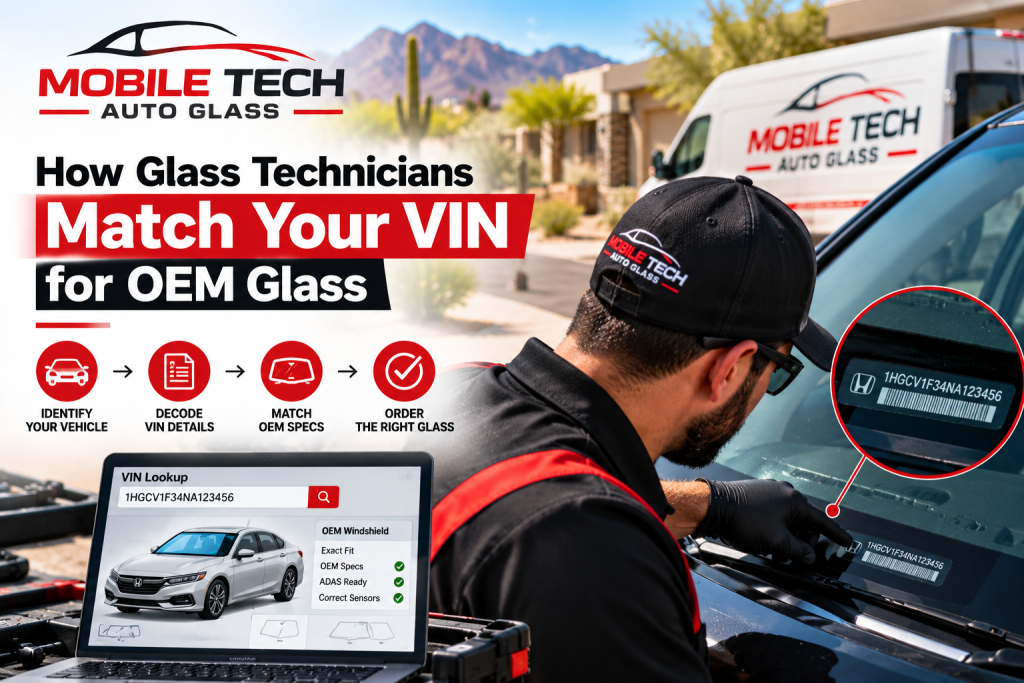
How we match your VIN step by step
Here’s what happens behind the scenes when you book a job with us.
Step one: We read the full VIN
We confirm all 17 characters. A single wrong character could well point to the wrong glass. We normally just ask the customer to read the VIN back to us or we check it against the photo they’ve sent. Errors do occur when people are guessing at a character so we take an extra minute here.
Step two: We check the model year and trim
The model year code gives us the production year. The trim and body style come from the VDS. We then cross that information against the parts catalog to separate the basic glass from the premium glass.
Step three: We look for the factory glass part number
Every windscreen has a part number on it (usually in the lower corner). The part number and the DOT code can be used to confirm that the glass is the correct glass for the car. We cross reference the part number against the VIN results so we’re not relying on just one source.
Step four: We confirm the sensors and features
Some of the features won’t be apparent in the VIN breakdown alone. We also look at your mirror area, your camera setup and your dash lights. If you have lane assist, auto braking or a rain sensor then we need to make sure the new glass has the correct mount and coating.
Step five: We order and test the fit
Once the glass gets here the tech will check the fit prior to installation. They’ll be looking at the bracket locations, the moulding and the mounting points. If there’s anything that needs to be calibrated post installation we’ll plan that in and let you know in advance.
Where to find your VIN
You don’t need to go digging through the paperwork to find it. The VIN will be printed on most cars in a number of places.
- The lower corner of the windshield on the driver side, visible from outside
- The driver side door jamb sticker
- The dashboard near the windshield, on the driver side
- Your registration card
- Your insurance card or policy documents
- Your title or purchase paperwork
If you take a photo of the windscreen corner or the door jamb label you can send that to us. A clear photo is useful as it saves us time and helps us spot any typos.
Common problems caused by a wrong match
Wrong glass shows up in a few predictable ways. Some are easy to spot, and others take time to appear.
- Sensors that misread. A rain sensor or camera may give false readings or stop working.
- Wind noise and leaks. A slightly different molding can let in water or air.
- Missing features. The defroster or heated wiper area may not work as before.
- Warning lights. Some vehicles show a driver assistance warning when the glass or camera setup doesn’t match.
- Poor fit at the edges. The glass may sit high or low, which can cause stress cracks over time.
The good news is that most of these problems come from a mismatch that can be prevented. Checking the VIN first is one of the simplest ways to avoid them.
Why calibration often follows glass work
Many of the newer cars will require a calibration after a windscreen has been replaced. The forward facing camera and lane assist system need to know precisely where the windscreen is. A calibration is what tells the system how to read the road again.
Calibration can be done on site with the appropriate tools or at a dealer or specialist centre. Your technician should tell you which is the required method prior to the work commencing. If they skip that step on a vehicle that requires it the safety systems may not operate as you’d expect.
What to ask your tech before the job
A good shop will answer these questions without fuss. Asking them helps you feel confident about the work.
- Did you read the full VIN and confirm the trim level?
- Is the glass OEM, or is it an aftermarket option? If aftermarket, which brand?
- Does my car need a camera or sensor calibration after the install?
- Are the brackets and sensor mounts the same as the factory setup?
- What warranty covers the glass and the labor?
- Will you check the features with me before I leave?
If a shop seems annoyed by these questions, that’s a sign to look elsewhere. Clear answers are part of good service.
Insurance and cost
Insurance companies will often request the VIN when they’re processing a glass claim. That number enables them to verify the coverage and the parts that have been approved. Some policies will only cover OEM glass, others will cover aftermarket. Call your insurer and find out which of those options your policy covers before you book the work.
The Insurance Information Institute explains how comprehensive coverage handles glass damage, which is useful background when you talk with your insurer.
The Insurance Information Institute notes that comprehensive coverage usually includes glass damage, so checking your policy before the repair can help you avoid surprises at the shop.
Cost is dependent on the car, the type of glass and whether or not calibration is required. OEM glass will generally be more expensive than aftermarket, though on some newer cars with complex systems it may actually save you time. We always lay out the options and the price to you prior to us starting.
Conclusion
Matching your VIN is all about getting the right glass for your particular car. The code will tell you the model year, the trim, the plant and the serial which in turn will give you the correct part. When you get it checked properly you get glass that fits correctly and will keep your sensors, cameras and all the other features working as they should.
Mistakes are made when you’re rushing the process. We’d rather take a few extra minutes on the VIN than spend a whole week fixing a sensor that never worked in the first place. A careful match is one of the easiest ways to protect your car and your own safety.
If you’re not sure which glass your car needs, contact the Mobile Tech Auto Glass team. Send us your VIN, and we’ll confirm the right part, explain the options, and tell you plainly what your car needs after the install.
FAQs
Can I find the right glass without giving you my VIN?
It’s possible to guess from the year, make, and model, but it’s risky. Trim levels and features can change within the same model year. The VIN removes most of that guesswork. If you don’t have the VIN handy, a clear photo of the door jamb sticker or the windshield corner works just as well.
Is OEM glass always better than aftermarket?
Not always. OEM glass usually matches the factory design closely, which helps with sensors and cameras. Quality aftermarket glass can work well on many vehicles, especially older ones without advanced features. The right choice depends on your car, your insurance policy, and how much the sensors matter for your driving.
Does the VIN tell the tech if my car has a rain sensor or camera?
The VIN gives strong clues about the factory equipment, but it doesn’t list every feature. Techs also check the mirror area, the camera mount, and your dashboard warning lights. Together, these details confirm what your car needs.
Why does my new glass need calibration if the old one worked fine?
The camera and sensor systems depend on the exact position of the glass. Even a small change can throw off the readings. Calibration tells the system how to read the road again. Without it, lane assist or automatic braking may not perform as expected.
What if the VIN doesn’t match the glass on my car?
Tell your tech right away. A mismatch can mean the glass was replaced before, the VIN was typed wrong, or the car has a different trim than you expected. A good shop will check the part number, the DOT code, and the mounting points before they install anything.